How to use consumer data to plan your seasonal marketing

Most seasonal plans start with the calendar. Better ones start with the customer’s mood.
The calendar gives you Easter, summer, back to school, Black Friday and Christmas. It gives you the dates everyone else can see too.
That creates the problem.
When every brand plans from the same dates, everyone briefs at the same time, targets the same moment and often produces the same work. The calendar tells you when to show up. It doesn’t tell you what people need from you when you arrive.
That’s why so much seasonal work lands generic – in tune with the date, and out of tune with the customer.
Customers don’t experience the year as a marketing calendar. They experience it as shifts in money, mood, energy, pressure and intent.
Seasonal planning gets sharper when it starts there.
Reframe seasons as emotional chapters
People don’t live in financial quarters. They live through emotional chapters.
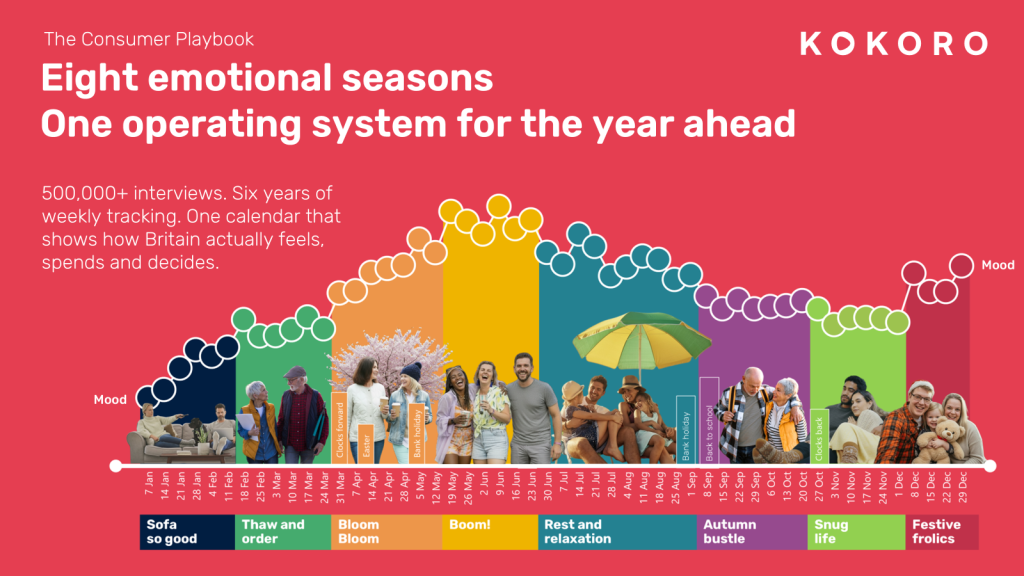
After Christmas, many households stabilise. Then budgets tighten. Spring brings a sense of thaw and order. Early summer can feel more expansive. Late summer stretches people. September brings rebalance. Autumn turns attention towards home. December carries both splurge and pressure.
Those shifts change what people notice. They change what feels worth spending on. They change the role a brand can credibly play.
The useful planning unit rarely comes down to “the season”. It comes down to the emotional job people need help with at that point in the year.
Do they want to reset? Save? Optimise? Stretch? Prepare? Treat? Nest? Get back in control?
The answer gives you a better brief than the date alone.
Get the chapter right and the campaign has somewhere useful to go. Get it wrong and the work can look perfectly seasonal while feeling emotionally off-key.
Why the build-up matters
It’s March, and we already know September.
That line matters because the campaign moment and the customer shift rarely start together. September activity may go live in September. The emotional build-up starts earlier.
Take the late-summer build-up into autumn – what we call Autumn Bustle.
By late summer, households start moving into reset mode. Routines restart. Belts tighten. Shopping lists grow. Contract reviews creep back in. People want value, control, preparation and small signs of progress. Home becomes HQ. Winter sits on the radar before the cold fully arrives.
By the time many back-to-school or autumn campaigns go live, customers have already been moving for weeks.
Brands without weekly visibility see the moment. Brands with weekly visibility see the build-up.
That difference matters commercially.
Seasonal planning goes wrong in three ways when teams miss the build-up.
First, they arrive too late. The customer has already started moving.
Second, they read the mood wrongly. They go big and celebratory when people want control, reassurance or value.
Third, they reuse last year’s assumptions. The date repeats. The customer context moves.
The calendar repeats. The customer doesn’t.
What consumer data should actually tell you
Good consumer data should answer four planning questions.
First, what mood are people in?
Cautious, restless, indulgent, stretched, optimistic, tired, anxious or ready for change? Mood shapes the tone before it shapes the message.
Second, what pressure do they face?
Money, time, health, family routines, work, weather, confidence, social expectations or emotional fatigue? Pressure shapes what people feel able to spend on, defer, swap or cut.
Third, what are they trying to do?
Rebalance, save, prepare, treat, reset, nest, simplify, feel capable or get back in control? Customers always have a job they’re trying to do. That job gives the proposition a way in.
Fourth, what role can the brand credibly play?
Restarter, smart choice, winter-ready partner, treat enabler, confidence builder, shortcut, protector or planner? The role sits where the brand’s permission meets the customer’s need.
This takes planning beyond “confidence up” or “confidence down”. Those measures help, though a number alone doesn’t carry the brief.
The useful data connects mood, life pressure and behaviour. It helps teams understand what people may buy – and why that choice makes sense in their lives at that moment.
That gives seasonal marketing a sharper commercial edge.
Five moves to plan around the customer
Map the emotional chapter, not just the event
Start with the customer state before, during and after the moment.
What are people moving from? What are they moving towards? What pressure rises? What energy drops? What trade-offs start to bite?
This stops the brief becoming “we need a September campaign”. It turns it into a customer problem the brand can help solve.
The event sits inside the chapter. The chapter does the work.
Find the shift point
Don’t ask only when the campaign goes live. Ask when the customer mood starts to move.
That shift point should shape the brief, media timing, retail messaging and offer strategy. It also helps teams avoid piling into the same noisy week as everyone else.
A better question: when do people start thinking, feeling and behaving differently?
The brief should land before that shift gathers pace, not after the customer has already moved.
Match the brand role to the mood
Take Autumn Bustle.
Some brands can play the rhythm restarter – helping people get routines back under control.
Some can play the smart choice – making better value feel satisfying, not second best.
Some can play the winter-ready partner – helping people prepare before pressure hits.
Those roles come from the customer’s life, not the brand’s internal calendar. They also give teams a way to choose between competing messages.
Don’t brief “September”. Brief “back to control”, “spend wisely” or “get sorted before winter”.
Different chapter, different role.
Build messaging around the job people are trying to do
Good seasonal messaging starts with the customer’s task.
“Back to it. Basics first.”
“Sort now, settle later.”
“Cosy, not costly.”
Those lines work because they speak to a real job in the moment. They don’t just dress a sales target in seasonal language.
The strongest seasonal lines name the job out loud.
The best seasonal marketing lands. The weaker kind merely turns up.
Brief the team in chapter-language
Marketing, creative and trading should be working from the same picture of the moment.
When the brief, the creative and the activation all describe the same customer reality, the work coheres. When they don’t, it shows up as a campaign that’s technically on-strategy and emotionally off-message.
Chapter-language gives teams a shared picture. “We’re planning into Autumn Bustle” lands harder than “we’re planning the Q3 campaign” – because everyone in the room can picture the customer.
The data underneath
You need the right data layer to plan this way.
Konfidant’s Consumer Playbook turns weekly consumer tracking into a seasonal planning input. It maps mood, health, home, identity, food, socialising, hobbies and everyday behaviour across the year, so teams can see how Britain actually feels, spends and decides.
Each chapter gives teams the national mood, life signals, story arcs, watch-outs, brand roles, messaging hooks and sector activations. It shows how confidence and sentiment shift before seasonal moments, not just during them.
The Playbook draws on 500,000+ interviews and six years of weekly tracking. More than 25 UK brands – including Tesco, HSBC, Aviva, Sky, BT, Aldi, ASDA, B&Q and Boots – use it to plan around the customer, not the calendar.
Aviva’s Marketing Planning and Creative team said it gave them “greater insights into consumer mood and behaviour at specific times of the year”, helping shape the Aviva Bright Start campaign.
The trade-off feels simple
Plan against the calendar and you’ll arrive on time. Plan against the chapter and you’ll arrive in tune.
Seasonal planning shouldn’t start with: “What campaigns do we need for each date?”
It should start with: “When will our customers start to feel differently – and what will they need from us when they do?”
Brands that see those shifts early can brief better, time better and sell with the mood, not against it.
See the next chapter before it lands.